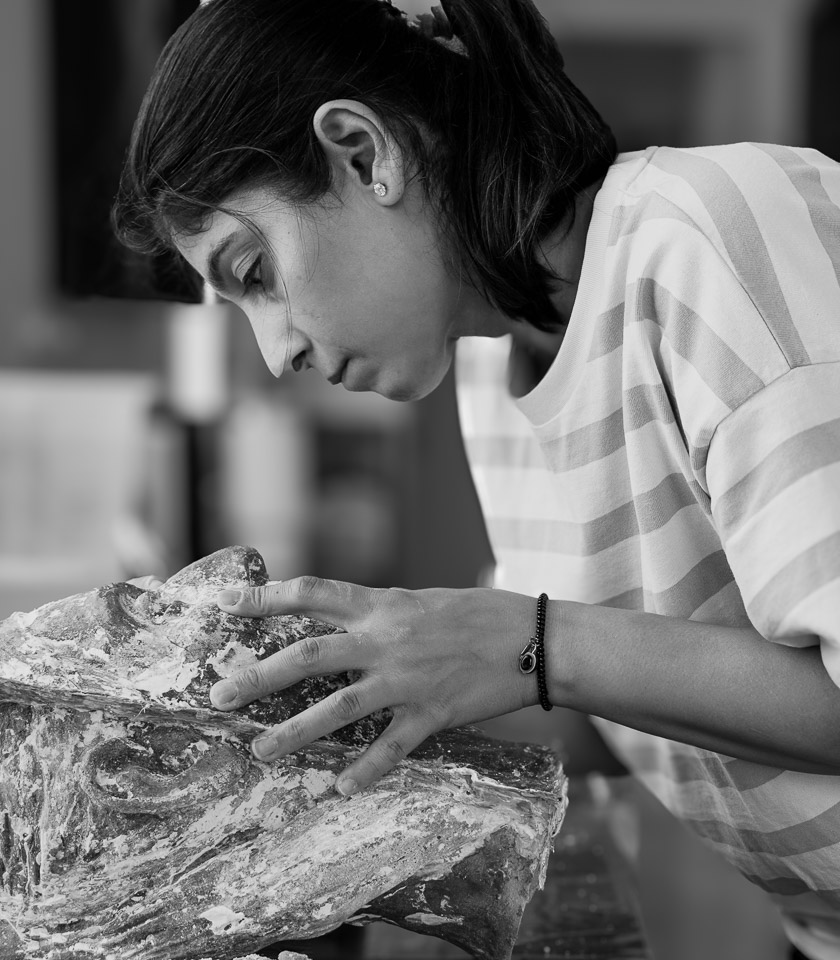
There is a point in every conversation with Mansha where the question you ask quietly becomes another question altogether. One thought leads to another. A memory interrupts an observation. A story circles back before moving on again. It can feel as though she is wandering. She isn’t. She is following an instinct.
That instinct has always been directed towards one thing.
The self.
Not the self as certainty, but as something assembled through memory, family, the body and experience. Something that is constantly being revised.
Her family came to India from Rawalpindi during Partition. She was born and raised in Delhi in a large joint family where affection and expectation often occupied the same space. Childhood was lively, noisy and full of food. It was also the time she became painfully aware of herself. Bullying at school and the quiet expectations placed on young girls made her conscious of her body long before she understood why.
She also remembers the name calling.
Children have an instinct for finding difference, and an equal instinct for turning it into ridicule. Those years left her deeply conscious of herself. What others dismissed as teasing stayed with her long after childhood had passed.
“I used to hide a lot,” she says.
That sentence explains more than it first appears to.
Most of us spend our childhood learning how to fit in. We learn what to say, how to behave and what parts of ourselves are better left unseen. It is a necessary education. It is also an incomplete one. Artists often spend the rest of their lives questioning everything that education taught them.
For Mansha, that questioning began early.
“When things are broken, you are left with fragments.”
It sounds like an observation. It is also the foundation of her practice.
She is not interested in fragments because they are visually compelling. She is interested in what they reveal. Memory arrives in pieces. Confidence disappears in pieces. Identity is built in pieces. We inherit stories that are incomplete, remember only parts of our own lives and spend years trying to assemble them into something that resembles a whole.
Leaving Delhi for Chennai was the first real break from everything she knew. Living alone in a hostel after growing up in a protective environment demanded a different version of herself.
“What Chennai taught me was to be independent.”
She studied design there, and design gave her discipline. It demanded rigour, precision and the willingness to return to the work every day.
Years later, a Tamil expression still slips into conversation.
Aiyyo Appa.
Some places leave more than memories. They quietly change the language through which we experience the world.
Design also taught her where she drew the line.
One day she was asked to copy an existing product.
“I didn’t train for so many years just to copy in the end.”
Her manager disagreed.
“I walked out of design.”
That moment says more about Mansha than any biography could. She did not leave because she disliked design. She left because she could not imagine spending a lifetime repeating someone else’s ideas.
Contemporary art offered another possibility.
A collage course in the United Kingdom opened that door. More than collage itself, it was the freedom of contemporary art that changed her thinking. Materials were no longer neutral. They carried memory, history and emotion. They could shape meaning as much as image.
She did not choose collage.
The materials chose the questions she wanted to ask.
Drawing, terracotta, plaster of Paris, paper and photography all appear in her practice. Paper tears. Terracotta cracks. Plaster breaks. These are ordinary facts. Inside her work they become quiet metaphors for the way lives are lived. Nothing remains untouched. Nothing remains complete.
Returning to India, she completed her Master’s at Shiv Nadar University. By then the work had found its direction.
Ask Mansha where her thinking happens and she does not mention books or conversation.
“The studio is where I do most of my thinking.”
Some artists think first and make later. Mansha makes in order to think. Every work becomes a way of understanding something she could not have understood beforehand. The studio is less a workplace than a place of enquiry.
Perhaps that is what makes her practice feel so honest. It never arrives with answers. It arrives with attention.
We like to believe our lives form complete narratives. Looking back, we edit events into stories that appear coherent. Reality is far less generous. We remember selectively. We inherit histories we never experienced. We carry old wounds into new places. We become different people without noticing when the change happened.
The self is never finished.
Mansha understands this instinctively.
Her work does not attempt to repair what has been broken or pretend that wholeness is possible. It simply asks us to look more carefully at what remains. The pieces. The gaps. The traces of lives still being assembled.
Perhaps that is all any of us can do.
Gather what remains.
Keep looking.
Begin again.