Michael Betancourt is an artist, filmmaker and writer whose work has shaped critical discussions around cinema, digital media and visual culture for decades. His engagement with abstraction, technology and perception makes him a particularly compelling reader of Malcolm Fernandes’ 7 Poems of Form Trapped in the Middle of Chaos or Time Held in the Arms of Love?. In this review, Betancourt moves beyond the film’s surface disruptions to examine its deeper concerns with memory, loss and the unstable relationship between place and representation. Through Fernandes’ fragmented images and distressed soundscapes, unfinished structures on the edges of Bengaluru become reflections on disappearance, transformation and the traces left behind by time itself.
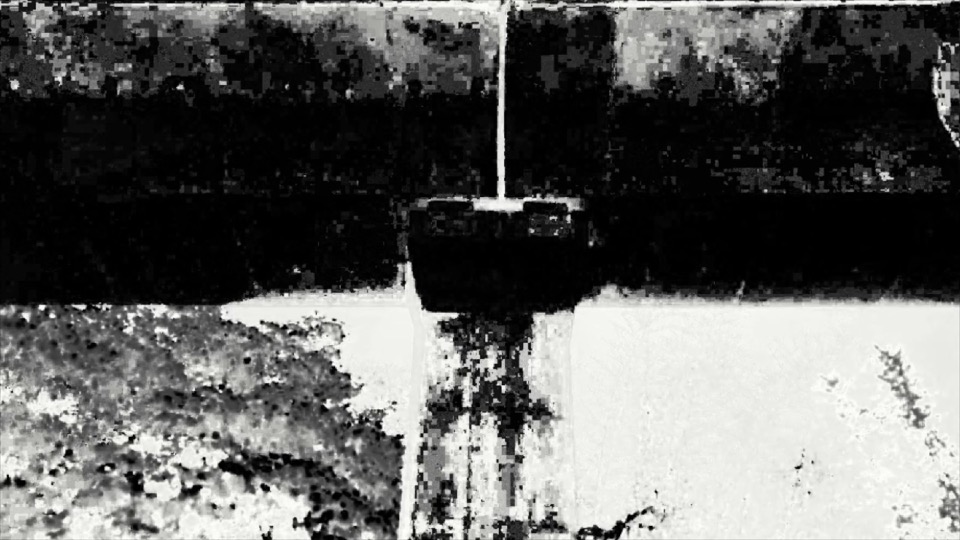
The question posed by the title, 7 Poems of Form Trapped in the Middle of Chaos of Time Held in the Arms of Love? invites the audience to see through the flickering grids of pixels and compression artifacts to consider what these fragments suggest. It is an invitation to ignore what would normally occupy the central position of consciousness—the glitches—and address what digital technology has transformed. This shift in attention away from the technical process itself completes a conceptual loop through this concern for depiction, drawing attention to our use of technology as a vehicle for memory and preservation that is often a replacement for precisely those things we wish to preserve. By emphasizing this subjective translation, Fernandes brings the transitory and unstable transformation of the mental landscape that defines memory into a direct dialogue with a built landscape composed of marginal spaces where construction has stopped, incomplete, leaving hollow frameworks that were never put into use, but which through these reveries become metaphors for loss and the erasures of memory.
Glitching removes the specific details of these spaces, leaving only their outlines as a trace that invites identification as a room, a wall, a window—but looking out into and onto an abstraction. Yet at the same time, the soundtrack grounds these reveries in the reality of urban spaces through the sounds of traffic and faint noises of everyday life whose distant, muted erasure belongs to the lineage of Luigi Russolo’s intonamuri—the noise machines at the heart of his Futurist compositions. These rhythmic noises ground the spaces in a specific way, addressing their abstraction and ambiguity by forcing the viewer to connect them to actual spaces that are revealed by the second half of the video, where the abstraction becomes familiar realism and the ambiguity vanishes into the mundane experience of spaces under indefinite construction, await a return to work.
Where the first section produces an evocative and emotional stillness, the second draws the viewer into a more topical consideration of urbanization and gentrification. This section, described in the title by “Time Held in the Arms of Love” evokes the comments by film theorist André Bazin in his essay “The Ontology of the Photographic Image”:
Whatever the objections of our critical faculties, we are obliged to believe in the existence of the object represented: it is truly re-presented, made present in time and space. [. . .] Seen in this light, cinema appears to be the completion in time of photography’s objectivity. A film is no longer limited to preserving the object sheathed in its moment, like the intact bodies of insects from a bygone era preserved in amber. [. . .] Only the impassive lens, in stripping the object of habits and preconceived notions, of all the spiritual detritus that my perception has wrapped it in, can offer it up unsullied to my attention and thus to my love. In the photograph, a natural image of a world we no longer able to see, nature finally does more than imitate art: it imitates the artist.” 1
The same concern for photography as a recovery that directs our attention to the anteriority of events—the temporal distance that becomes physical in the change from lived experience to mediated encounter—allows viewers to address these images of incomplete and unfinished spaces that remain (forever) under construction in these shots reveals the nostalgia at the heart of motion pictures–as–recording. But this fragmentary nostalgia can neither be for the space we see in these scenes, nor can it be for what these spaces will become. Instead, it draws attention to precisely the erasure created by the unfinished construction sites in themselves: these buildings yet–to–be are incomplete erasures of what was there before, a lost space that has not been completely replaced, but has been entirely removed. The subtle sounds of the street outside serves as a grounding of this reverie in relation to an oncoming modernization that transforms by replacing, and in substituting itself for what was, does not always offer anything as replacement. This change is the logic of replacement and creative destruction where the past is swept away and the future remains propositional—its pairing with the transcendent meditations offered by technological abstraction (the glitches) fragments the presentation and reinforces the differences between the opening suspension of time and its collapse into both the immediacy of the immanent encounter (the event of these spaces shown on screen) and their unquestionable anteriority to the viewer. In being recognized they become historical, even if it is the instant history of the digital snapshot. The dualities the link and separate the two halves of this video work thus converge on the same significance: that the reverie which media enables is always immanent, immediate, instantaneous, but its understanding shifts depending on the simple familiarity of the imagery and its capacity to hold time itself up for our interrogation.
1 Bazin, A. What is Cinema? trans. Timothy Barnard (Montreal: Caboose, 2009), pp. 8-9.
Michael Betancourt
michael@michaelbetancourt.com