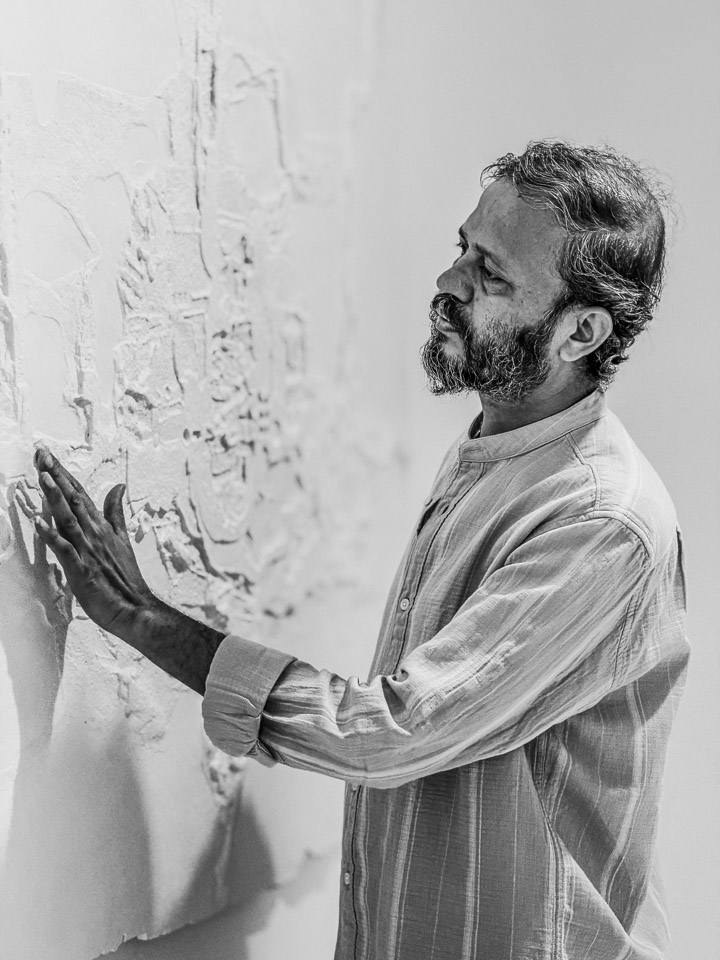
I have known Balasaheb Chaudhari for about four years now. Balu, as he is affectionately known, is a reserved person. Reserved to the extent that one could easily mistake him for a recluse. Conversation with him takes a little effort, and getting to know him takes time. Over the past year or so, though, I have seen a change. He has opened up a little. What I initially understood as being reserved has gradually revealed itself to be shyness. There is a certain warmth that emerges once he is comfortable, and I have come to enjoy our conversations.
Our association began quite by chance. Balu had come to the gallery to repair a work by another artist. We got talking, and that conversation eventually developed into an association that has continued over the years. What struck me during that first meeting was how attentive he was. He spoke little, but listened carefully. He seemed to absorb everything around him. Looking back, I realise that this quality of observation is something that also finds its way into his work.
A few days ago, we sat together again, this time to talk about his forthcoming solo exhibition. As we spoke, I found myself revisiting the journey that had brought him here. Balu himself felt that he had come a long way.
Originally from Maharashtra, he grew up in a small village near Pune. His earliest memories of art go back to his childhood and his interactions with an artist uncle. His uncle involved him in portraiture and sculptural work, giving him an opportunity to experience the process of making things at a very young age. He remembers enjoying those experiences. There was an early attraction towards working with his hands, understanding materials and giving form to things.
He went on to study in Pune, but opportunities were limited. His move to Bhopal became an important turning point. He describes it as one of the best things that happened for his learning. It was here that he began exploring printmaking and paper embossing. These experiences gave him an understanding of surface, depth and the possibilities of working with materials. What began as an exploration gradually became the foundation of the relief works that are now central to his practice.
The early years were a struggle. Finding one’s footing as an artist takes time, and Balu had his share of uncertainty. He spoke quite openly about how finding the gallery changed things for him. The support and encouragement he received gave him confidence, and he feels that the past few years have been particularly important in his development. His forthcoming solo exhibition is a culmination of this period, and a moment that I know means a great deal to him.
When we spoke about his work, he returned to something that has always been close to him. Nature and the things around him. He is attracted to natural forms, their colours, textures and the small details that often escape our attention. These observations become starting points for his work. Yet, he is equally conscious of leaving room for the viewer. He does not wish to define what a work should communicate or direct someone towards a particular interpretation. He prefers abstraction to remain open.
I find this interesting because it says something about his relationship with art. He knows where a work begins, but is willing to let it travel elsewhere. His personal associations remain with him, while the viewer is free to bring their own experiences to the encounter.
Over the years, his relationship with materials has grown considerably. His relief works on paper and metal have established a distinct visual language, built through layers, impressions and variations in surface. There is a physical quality to these works that asks for closer attention. They occupy a space between painting and sculpture, retaining the intimacy of a surface while creating depth and dimension.
The forthcoming exhibition will bring together works in paper, cement and metal. Each material offers a different possibility, and each asks something different of the artist. I am particularly interested in seeing how these explorations come together. They reflect a willingness to keep learning and to allow the practice to grow beyond familiar territory.
What I find appealing about Balu is that he has never seemed particularly interested in making a statement about himself. He is more comfortable allowing the work to speak. His personality and his practice have something in common. Both take time to reveal themselves. You have to spend time with him, just as you have to spend time with his works.
There is also something reassuring about watching an artist find confidence at his own pace. We often speak about ambition, visibility and recognition in the art world. Yet, the actual journey of an artist is usually a much quieter affair. It involves years of learning, uncertainty, experimentation and the occasional encouragement that helps one keep going. For Balu, the past few years have been an important part of that process.
As I look back at our first meeting, I find it rather remarkable that a chance encounter, with an artist who had come to the gallery to repair someone else’s work, has brought us to this point. I have watched him grow more comfortable with himself, more confident in his practice and more willing to share what goes into his work.
His solo exhibition is an important milestone, but I see it as one chapter in a much longer story. There is still much to explore, and I hope he continues to give himself the time and space to do so.
Balu has come a long way. I am happy that our paths crossed when they did. Sometimes, the most meaningful associations begin without any particular expectation. They simply grow, one conversation at a time.