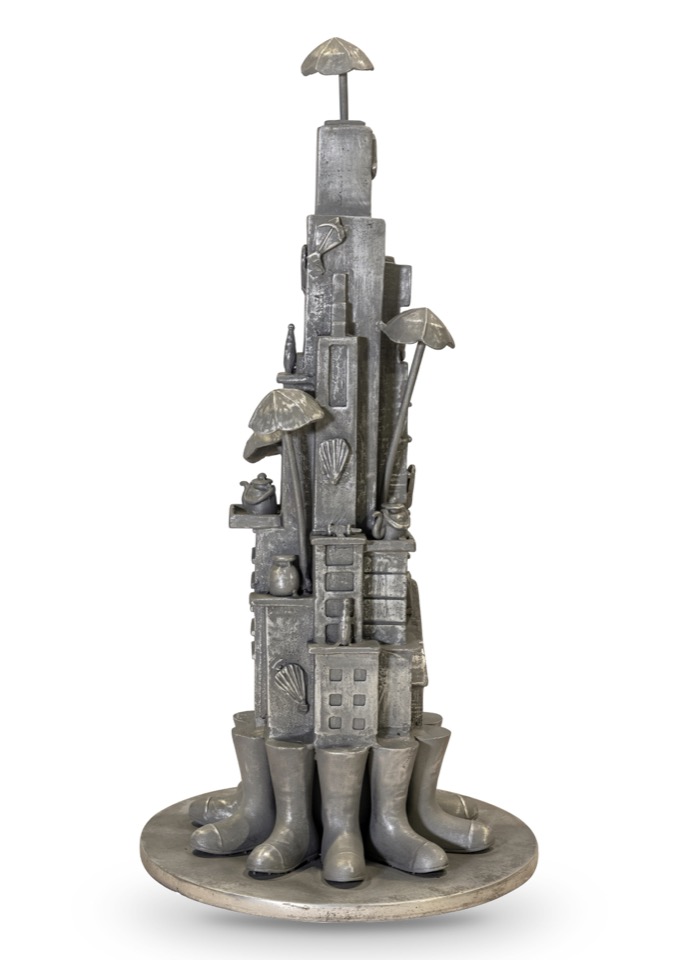
Suchit Sahni’s Nostalgia series sits in that rare space where memory feels close enough to touch. He works with metal, yet the mood is gentle. He leans into objects that shaped everyday life in urban India during the eighties and nineties. Things many of us handled without thinking. A kite that once drifted across summer skies. A tea kettle that stayed on a family stove for years. Rainboots that carried a child across puddles. Buildings that framed early dreams. Each object becomes a marker of a life already lived.
He grew up in a city shaped by liberalising markets and satellite television. Western cues entered homes through ads, music channels and imported toys. His work mirrors that shift. The forms feel familiar to anyone who grew up in that period. A slight western flavour sits comfortably with an Indian core. He captures the confusion and excitement of that era. Many families held on to old routines even as new influences arrived through screens and shop windows.
Metal gives his sculptures a presence. The three dimensional approach pulls the viewer into the work rather than keeping the experience flat. You can see edges and dents. You sense weight and weathering. This material choice turns simple objects into monuments. A kettle or a kite starts to feel like a relic from a shared time. Metal holds memory with a firmness that paper or canvas rarely achieves.
His objects carry more than charm. They signal a desire to reclaim a part of life that often gets pushed aside in adulthood. The speed of present day India leaves little space for quiet recollection. Sahni urges viewers to slow down. His sculptures act like reminders to recover the good parts that shaped us. A kite stands for play. A kettle stands for long conversations. Rainboots stand for carefree wandering. The buildings stand for ambition before pressure arrived. These memories still have value.
Viewing his series feels like walking through a catalogue of lived experience. People from various cities will find something that echoes their own past. The nostalgia feels honest. The metal surfaces give enough grit to avoid sentimentality. This balance gives the work depth. He wants viewers to reconnect with themselves, not escape into fantasy.
Sahni also pushes a quiet point about culture. Objects from daily urban life deserve attention. They carry history. They reveal shifts in taste, aspiration and identity. A television cartoon or a popular cold drink style can reflect social change as clearly as a political event. His sculptures preserve these details and argue for their importance. Memory becomes a tool for understanding who we became.
The strength of the series lies in its clarity. He picks objects that once felt ordinary. Through scale, form and material, he lifts them out of the background. The viewer feels an urge to touch them, trace them and recall their own version of that object. This interaction gives the work energy. The past becomes active again.
The Nostalgia series works because it remains grounded. Sahni’s aim is simple. He wants people to remember who they were and carry that honesty into the present.