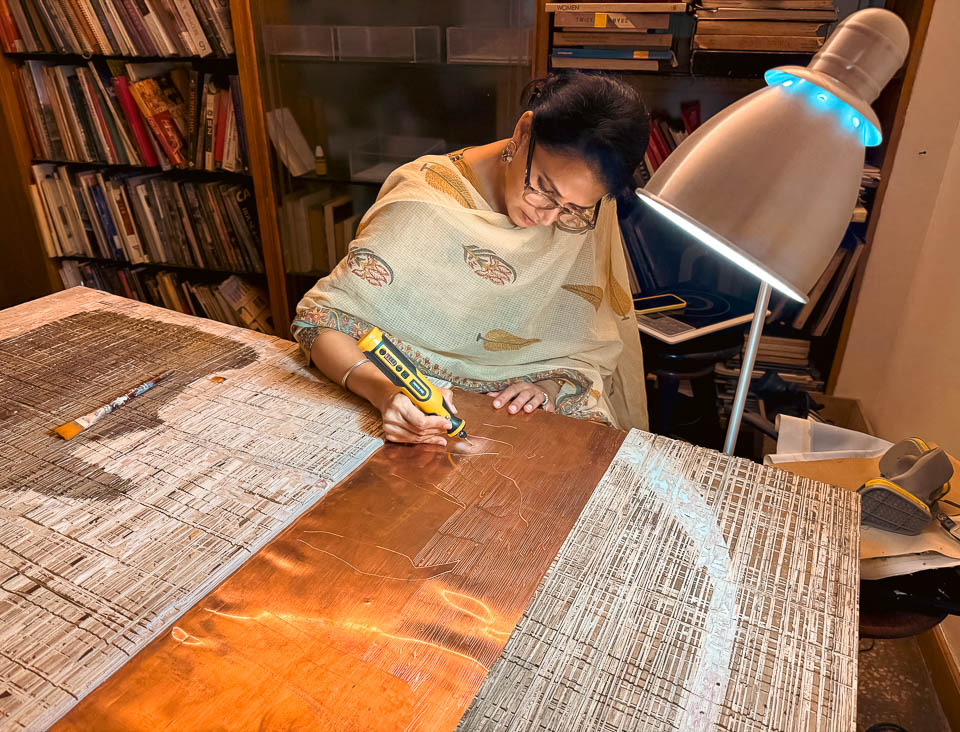
Ahead of her presentation at Art Mumbai 2025
Q1. The past two years seem to have been an important phase for you. How have they shaped your practice?
The past two years have been rejuvenating. I’ve had time to step back, look at my work with distance, and return to it with more energy. The conversations with the gallery have been refreshing. Having someone see the work from another lens has brought a new rhythm to my thinking. My process feels more grounded now. I’m working with intent rather than habit.
Q2. Where do you feel your work stands today?
It feels more cohesive. There’s more clarity, less noise. I’ve stopped worrying about how it should look and started paying attention to what feels honest. The idea is to be as true to myself as possible. When that happens, everything else falls in place—the materials, the forms, even the silences within the work.
Q3. Conceptually you have relied on architecture, history and the Mehrab. Can you elaborate?
As an artist I’ve always relied on architecture and history, especially the Mehrab, which is close to me in symbolic ways. These have been at the core of my exploration from the start. They give my work a sense of continuity and anchor. As I evolve, I’m working with different aspects of the same broader theme—personal perspectives within these larger ideas. Some pieces draw directly from architectural motifs, others from how memory holds space. As I go deeper, I might define these elements further or leave them more open. The key is to enjoy the process and express freely. Let’s see where it takes me.
Q4. Your material choices are expanding. How do you approach them now?
The material is important, but it’s not the centre of everything. I see it as a language that carries the idea, not define it. Conceptual depth matters more to me. For the first time, I’m working with copper and wood alongside other metals, paper and cement. Each brings a different weight, both physically and symbolically. Copper, for instance, feels alive—it changes with time. Wood brings warmth. The mix creates an interesting dialogue within the work.
Q5. Tell us about the new elements we might see in your upcoming works.
There’s a lot happening with scale and form. I’ve been playing with sharper lines and larger shapes—they create a tension I like. I’ve also been exploring the Abugida script. It came into the work almost intuitively. It adds another layer of depth, a way to speak without saying too much. It’s a visual code, something between text and abstraction. It allows the work to hold a sense of quiet language.
Q6. You’re also preparing for your solo soon. How are you balancing that with the fair?
It’s intense but exciting. I’m in the studio every day, building towards both. The works for Art Mumbai are part of the same larger body that will continue into the solo. There’s continuity in the thinking, but each piece has its own presence. I like that the fair will give people a glimpse of what’s coming next. It feels like the right moment to share where the work has arrived.
Rubkirat Vohra’s works can be seen next in Art Mumbai at Booth C42. 13th to 16th November.