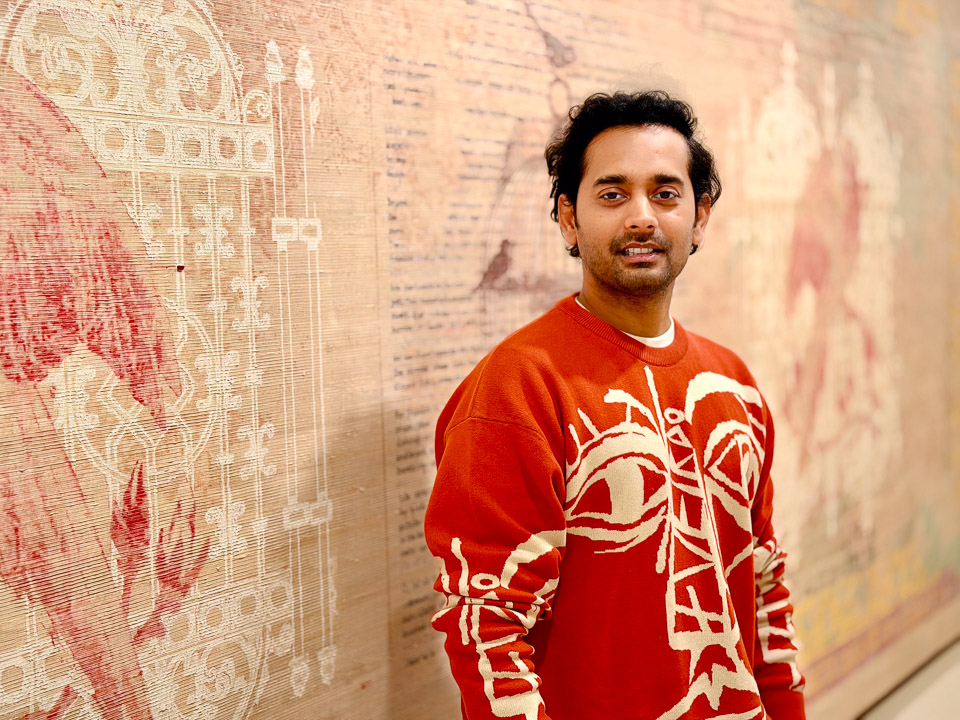
On his first solo exhibition
This is your first solo exhibition. How was the process of creating these works?
Creating the works takes time. The act of painting itself moves fast for me. That part feels instinctive and physical. The real challenge sits elsewhere. Deciding what to make and what deserves to be shown is far more complex. A solo asks you to take responsibility for every image in the room. You start questioning intent, sequence, and honesty. I spent a long time editing myself before the final selection came together.
Your work often brings history into dialogue with the present. How do you approach this relationship?
I work with both history and contemporary life. They exist together whether we acknowledge it or not. I place them side by side and let the tension speak. Juxtaposition helps create meaning without explaining too much. History gives weight. The present gives urgency. When they meet, the message becomes sharper and more uncomfortable.
Humour and satire play a strong role in your work. Why do you return to these tools?
Satire and humour are extremely difficult to communicate visually. If handled carelessly, they can weaken the work or make it feel shallow. I stay alert to that risk. For me, humour becomes a way to hold attention before the viewer realises what they are looking at. I stay away from direct political statements. I am apolitical by nature, yet I am deeply affected by what unfolds around us. That tension filters into the work in quieter ways.
This exhibition shows two distinct visual styles. Can you speak about that shift?
One body of work continues my use of texture and familiar elements. It builds layers and density through surface and form. The other direction is more restrained. The surfaces are flatter, the language simpler, yet the colours remain bold and saturated. Both approaches come from the same place. They allow me to say different things without repeating myself. The contrast felt necessary for this moment in my practice.
Know more about the show here.