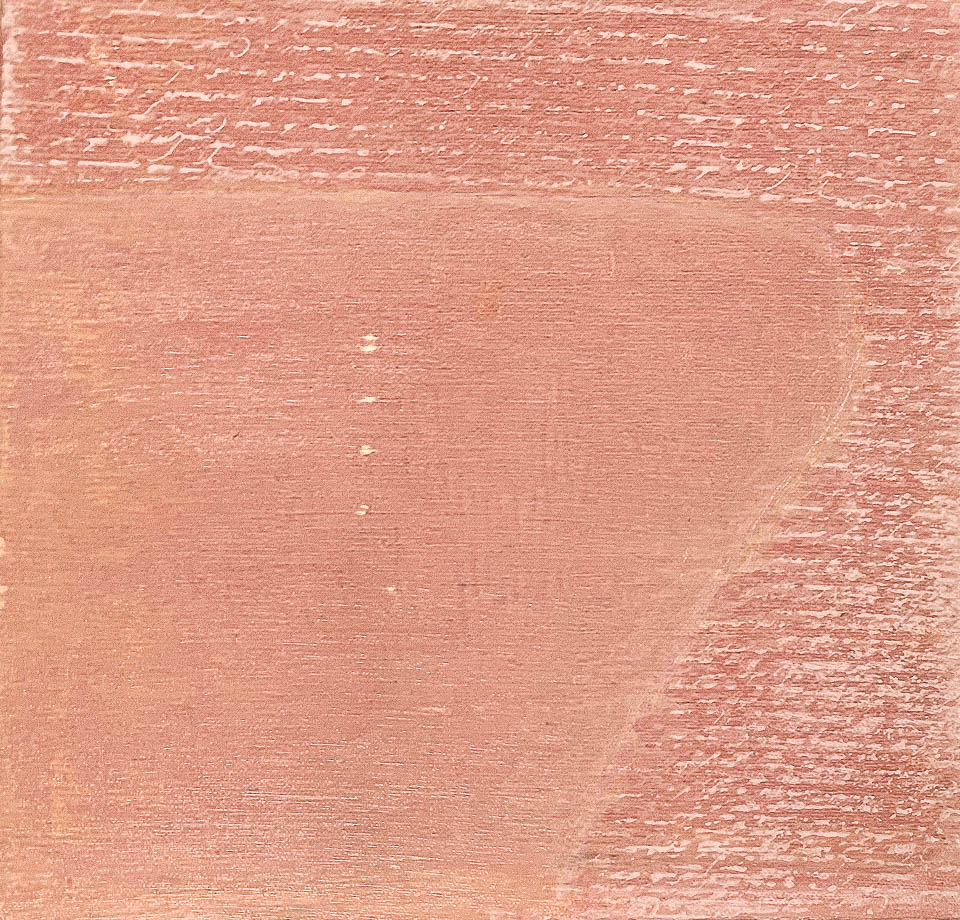
Kiyomi Talaulicar works in attention. Her paintings appear minimal at first glance. Sparse forms, quiet surfaces, subtle textures. Air space dominates. But spend time with them, and you notice the weight in what is not there. Every pause, every mark, every layer is deliberate. Nothing is wasted, nothing accidental.
Her practice is about life in its duality—its unpredictability, its movement, its fragile persistence. She describes it as “affirming eager reverence towards life as a singular vision, despite its dual nature.” That singular vision is about observation. It is about finding form in the flux, and giving it the space to exist, lightly but insistently.
Her works move between abstraction and suggestion. At times, they are fields of texture and tone, almost entirely non-representational. At other times, a fragment enters—a door, a chair, a leaf. These elements are sometimes literal other times not. They act as anchor to a narrative. They linger like memory fragments, half-formed, half-remembered. They are reminders that endurance is subtle, personal, and often fragile.
The process is instinctive, but disciplined. Layers accumulate, but with care. Colour carries emotion. Shape carries weight. White space carries thought. Every decision matters. Talaulicar’s restraint is deceptive. The work seems quiet, but it demands the viewer’s presence. It asks for attention, patience, willingness to linger. The meaning does not arrive fully formed; it emerges in the act of looking.
Placed within the context of What Must Endure, her work contrasts with Throngkiuba Yimchungru’s. His pieces carry collective memory, the weight of material and ancestry. Talaulicar’s work carries what is fleeting, personal, emotional. She preserves traces that might otherwise disappear: the residue of feeling, the echo of a gesture, the subtle imprint of experience. Memory, in her hands, is not fixed; it is lived, observed, reflected, and then released.
Her work challenges how we think of minimalism today. In a culture obsessed with immediacy and drama, she demonstrates that restraint can carry intensity. Silence in her work is active. Absence is pressure. Colour is not decorative—it is a register of emotion. Forms hover, fragments appear and recede, leaving space for the viewer to inhabit, to move within, to engage.
What endures in Talaulicar’s practice is subtlety. Presence. Care. The work reminds us that memory survives in observation, attention, and the quiet insistence of what matters. Her paintings endure in silence. They teach that endurance can be gentle, intimate, almost invisible, yet fully felt.
In these works, life’s duality is acknowledged without being resolved. Its unpredictability is met with attention. Its fragility is affirmed. Talaulicar shows that meaning is not always visible, often not obvious, but always vital. Memory is traced in fragments, textures, sentiments and pauses. Her work insists that noticing these traces is the start of the process of revealing and of what must endure.
Artwork: THOUGHTS AND SILENCE, Mixed Media on Canvas, 12 x12 inches, 2025,
WHAT MUST ENDURE STARTS 22ND SEPTEMBER.