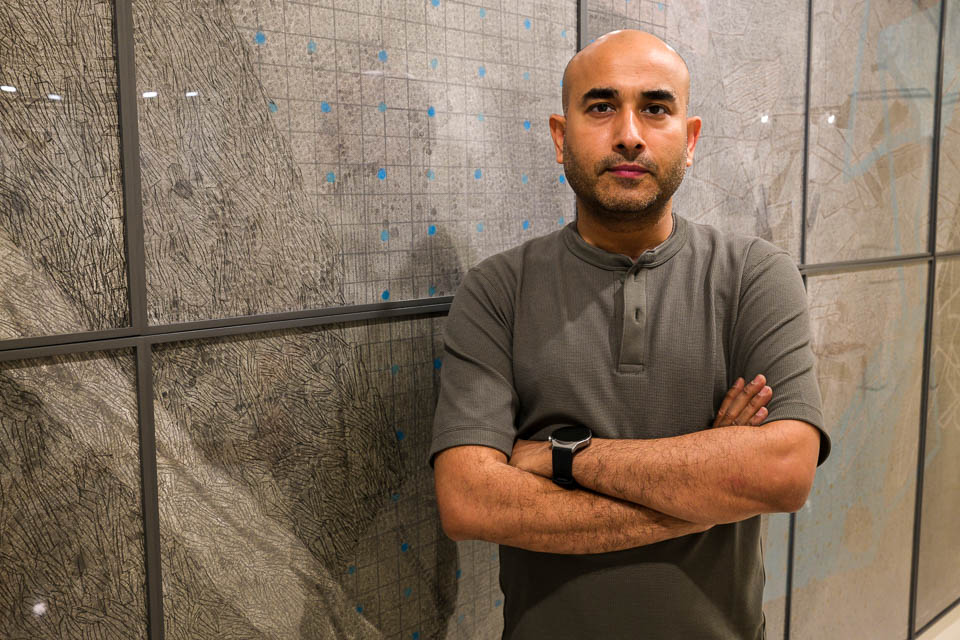
When Abhijit Pathak landed in Monaco for his six-month residency, he stepped into a slower rhythm—fewer people, fewer distractions, and far more time to observe. What began as a pause from the usual pace of Delhi’s art world turned into a quiet but powerful shift. Without the buzz of exhibitions or critique, Pathak turned inward and outward at once—towards nature, memory, and material. The residency became less about output and more about tuning in.
Q: Coming from the chaos of India to the quiet of Monaco must’ve been disorienting. How did that shift affect you?
It was a complete contrast. Back in India, there’s always noise—people dropping by, traffic, constant distractions. In Monaco, I had none of that. Very few interactions, very little social noise. At first, it felt empty. But slowly that emptiness became space. I could think, observe, and not rush. That changed my rhythm entirely.
Q: What role did nature play in this shift?
A huge one. I was seeing nature with a kind of clarity I’d forgotten. In Monaco, the light has a softness, almost sculptural. It reminded me of Ajanta—the shape of eyes, the quiet power of gesture. I stopped looking for ideas and started noticing what was already there.
Q: You usually work with a wide range of materials. How did you cope with having only the basics?
It stripped everything down. I had just canvas, paper, and pencil. That kind of limitation can be frustrating, but also freeing. I started working with sound. I built a video installation. If I had all my usual tools, I might not have gone there. The lack became the trigger.
Q: You also saw Anselm Kiefer’s works during this time. What did that do for you?
Seeing Kiefer’s work in person—massive, material-heavy, unapologetically tactile—was a shock. You can’t experience that in a book or online. It reminded me how important it is to stand in front of art, to let it physically affect you. That encounter shifted my sense of scale and surface. Travel does that. It recalibrates your seeing.
Q: Amid all these new stimuli, how do you stay authentic?
You can take in new influences without losing yourself. That’s the challenge. I’m not trying to sound European. Even when the tools change, I want my work to carry traces of where I come from—through rhythm, memory, texture. It has to remain mine.
Q: Looking back, would you call this a successful residency?
Yes, what I got was solitude, reflection, and a shift in direction. It became less about output, more about listening—to the place, the process, and the parts of myself I usually ignore. That was the real takeaway.
Reflections of Monaco, brought together the works Abhijit Pathak created during this quietly transformative residency. It charted a personal shift—how place can recalibrate perspective, and how time away can sharpen the core of one’s practice. Through paintings, photographs, drawings, and video, the show captured the residue of Monaco’s light, calm, and clarity. What emerged was a deepened commitment to listening—to material, to memory, and to the subtle ways a place can reshape an artist’s voice.