Nostalgia has become one of the most urgent subjects in contemporary art because modern life is forgetting itself too efficiently.
We document everything.
We retain very little.
Photographs disappear into phones. Personal histories survive as invisible files stored somewhere in distant servers. Entire emotional lives are reduced to digital storage. Contemporary culture preserves data. It rarely preserves emotional truth.
Against this condition, artists working with physical memory carry unusual importance.
understands this with remarkable clarity.
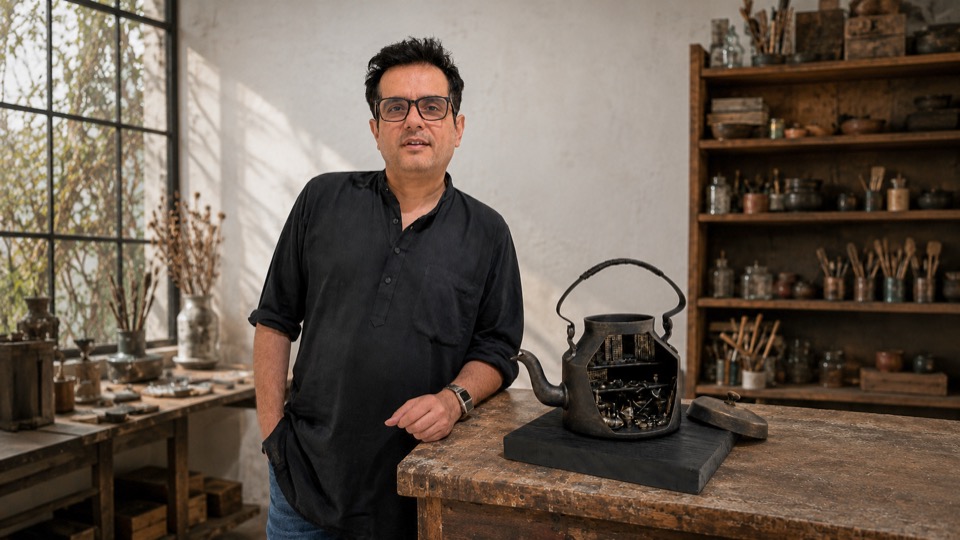
His twelve inch metal kettle from the Nostalgia series does far more than recreate a domestic object. The sculpture restores emotional weight to something contemporary life would otherwise leave behind. A kettle like this once existed quietly inside countless urban Indian homes. It sat on kitchen stoves during monsoon afternoons, slow mornings and long conversations before life became accelerated beyond recognition.
That familiarity becomes the emotional entry point into the work.
The object feels deeply personal, yet almost collective in its memory. Most viewers recognise it instantly. Not because the form itself is extraordinary, but because objects like these absorbed ordinary life silently for decades. They witnessed exhaustion, celebration, financial anxiety, family rituals and intimacy without ever demanding attention.
Objects remember us more honestly than photographs do.
Photographs perform.
Objects endure.
That distinction sits at the centre of Sahni’s practice.
The kettle is intimate in scale, yet psychologically expansive. Unlike his larger sculptures which dominate space physically, the twelve inch format forces closeness. The viewer leans inward. The experience becomes private rather than theatrical. Smaller sculptures access memory differently. They activate fragments buried beneath routine and distraction. The smell of tea. Rain against windows. The sound of utensils in another room. The comfort of knowing somebody else was awake in the house.
Small things.
Almost nothing.
Yet somehow those fragments become the emotional architecture of an entire life.
Sahni understands that memory rarely survives through monumental events. It survives through objects. Through repeated gestures. Through atmospheres that once felt ordinary enough to ignore.
That insight gives his work depth beyond nostalgia as aesthetic trend.
Many contemporary artists use nostalgia superficially. Retro imagery and childhood references often collapse into sentimentality or visual comfort. Sahni avoids that entirely because his sculptures remain grounded in materiality, restraint and psychological truth. Metal changes the emotional reading of the object completely. A kettle becomes archaeological. Domestic memory becomes cultural evidence.
The material itself matters enormously.
In a culture increasingly dominated by screens, the tactile presence of sculpture feels almost radical. Sahni’s works occupy real space. They cast shadows. They carry texture, density and resistance. The viewer registers dents, marks and imperfections. Sculpture slows people down. It demands duration. It asks viewers to physically exist alongside memory rather than consume it passively through images.
That is precisely why this work feels so relevant today.
Sahni belongs to a generation shaped by India’s economic and cultural transition during the eighties and nineties. Liberalisation altered aspiration, taste and domestic life permanently. Satellite television entered homes. Western advertising merged with older Indian routines. Families existed between two psychological worlds at once. Older habits remained intact while newer ambitions arrived through television screens and consumer culture.
His sculptures quietly preserve that tension.
The monochromatic bronze surface becomes crucial within this framework. Most memories eventually lose clarity. They flatten into tonal impressions and emotional residue. Sahni captures this beautifully through his restrained metallic palette. The bronze finish avoids decorative seduction completely. Instead, it creates stillness, age and distance. The sculpture feels suspended somewhere between relic and recollection.
This restraint is what gives the work credibility.
Sahni never romanticises nostalgia blindly. The surfaces retain grit. Imperfections remain visible. The object feels lived with rather than idealised. That tension prevents the work from collapsing into comfort. Instead, the sculpture asks more difficult questions. What parts of life disappear first when societies modernise too quickly. What emotional spaces survive adulthood. What happens to memory when attention itself becomes fragmented.
Maybe adulthood is just the slow replacement of memory with productivity.
That thought lingers throughout the work.
There is also a larger cultural argument embedded inside these sculptures. Everyday urban objects deserve preservation because they reveal shifts in class, aspiration, domestic behaviour and identity as clearly as political history does. A kettle can speak about migration, middle class ambition, changing family structures and generational transition. Sahni elevates overlooked objects into markers of cultural memory. He treats ordinary life with seriousness.
That decision feels increasingly important now.
Contemporary life produces endless images but very few lasting objects. Devices become obsolete. Platforms disappear. Digital memory remains unstable by nature. Sahni’s sculptures resist that instability completely. Metal survives physically. It ages with dignity. It remains touchable. In many ways, his practice argues for the return of tactile memory itself.
Few contemporary artists working with nostalgia balance emotional accessibility and conceptual clarity this effectively. Sahni’s sculptures feel immediate, yet they continue unfolding intellectually long after the initial encounter. They are contemporary without abandoning history. Emotional without becoming sentimental. Familiar without losing complexity.
The twelve inch kettle demonstrates exactly why Sahni’s practice deserves serious attention from collectors and institutions alike. He is building a body of work around memory, material and cultural transition at a moment when all three subjects are becoming increasingly urgent.
Artists capable of transforming ordinary objects into emotionally charged cultural artefacts rarely remain accessible for long.
Collecting Suchit Sahni now feels less like speculation and more like recognition.
Used with permission from art dose