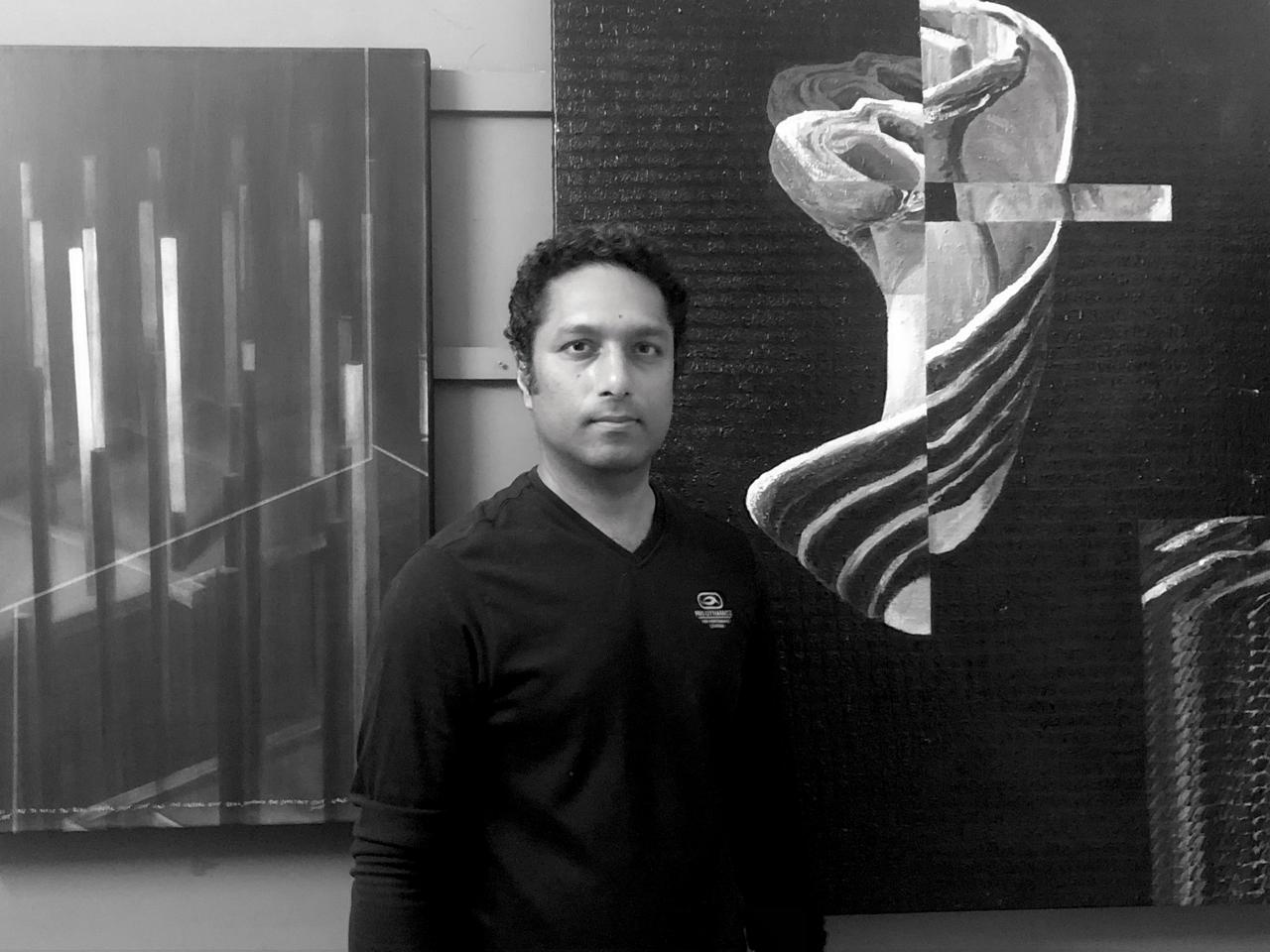
Tell us about your background.
My formal training is in fashion design and later in Corporate Learning and Development, where I spent several years.
I grew up with the creative arts all around me, and I was fortunate to have parents and family who enjoyed the arts as well—music, books, movies. And that’s been a huge influence.
My father painted in oils from his youth, and he was the first to show me the ropes around a canvas. Getting access to his paints and toolboxes and independently working on projects was a game changer for me. Discovering that you can have an idea or picture in your mind and then work to bring it to life—there’s really nothing like it.
I watched my father do that over and over, and I think I really picked up on the attitude and mindset needed in that creative process.
In addition to that, I think my experience designing and running learning programs in the corporate sector gave me the confidence and information I needed to self-train in the arts. I did so by dedicating about four or five years, focusing on studying formal art and design methods before I started showing my work in 2022. And I’ve been at it ever since.
Give us more information about your concept, how you come about it and how you work on it.
I’m fascinated by the creative act of building and bringing things into existence.
Construction sites and other “structures in transformation,” as I like to call them, are perfect testaments to the ability we have to bring physicality into existence. Of course, we think we are only creating for utility—especially when we build homes, bridges, places of worship, and the like—but we’re doing so much more.
And cast within various contexts of light, shadow, time, and transition, these sites turn into mirrors that reflect so much—the past and the present, the creator and the spectator, silence and noise, etc.
Then, of course, there is the story of these places. One sees an abandoned structure or site and can’t help but speculate: how old is the place? Who built it and occupied it? Why did they leave? And so on and so forth.
As far as my work process goes, making a work usually starts with looking at the real world around me, capturing it through multiple photographs or field recordings, and then experimenting with translation, composition, and design before any execution of the actual work.
Tell us about the current works displayed in the show and what you’ve been doing.
There are five works that are extrapolations of the spaces around the city where I live. All are presented in a manner that is fleeting and obscure, as if being seen at night or through an old picture frame.
I wanted to present the idea of Holding the Gaze as a challenge that stems from the realities of the city that most of us live in. That, and the idea that we are in fact surrounded by stillness. There’s nothing more at rest than a pillar or a dilapidated building, even if it is in the middle of Main Street. The chaos lies elsewhere.
And the current series is a reflection of that idea.
Why do you use varied mediums and what are the reasons behind it?
I like the idea of a recurring theme, especially if it’s told in different mediums or different languages, as I like to think about it. Between that and my diverse background and influences, I find using multiple mediums a very natural thing.
Tell us about the film you made for the show, and how it adds to your practice.
7 Poems.. is made up of seven scenes of construction sites that have stagnated for a while in the urban chaos of the city. Each scene is presented with literal and contextual fragmentation. Each scene holds the viewer’s gaze for about a minute and is presented once with the visual data glitched while the audio is kept intact, and a second time with the visual intact and the audio corrupted.
As I mentioned before, before starting this project, I knew I wanted to create a work that spoke to the theme Holding the Gaze as if it were a challenge—a challenge to find your center, right where you are. And that’s really what prompted the video, as well as the drawings and paintings.
The film also echoes the motifs that appear in the paintings and drawings, but in a moving image format made using tools of modern technology. I like that dichotomy of media—working with charcoal, which is one of the most primitive mediums, and working within the glitch/error context, which uses the latest in modern technology.
What are you working on as of now?
The theme of Holding The Gaze is quite an intriguing one. There were several ideas that did not make the first cut for one reason or another. And for all intents and purposes, the project is still ongoing for me, with more works to come.
Know more about the show here.